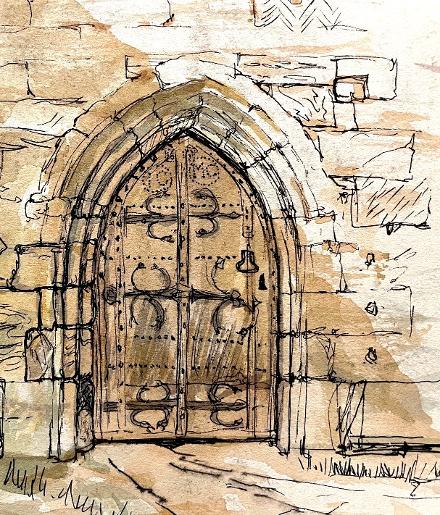
Ths lovely stonework is brought alive by the use of a sepia shadow - and all those small details in the studs, crusty metalwork and textured carvings... how best to describe them with nothing but a pen and a simple palette of watercolours? We will use a selection of different marks with our pen to bring out the character of this old doorway. Using a very simple palette of limited colours, you will use this restriction to help you focus and use the overlapping shadow to throw the sunlight casting across your work.
All the elements in this scene are chosen to be easy to draw, and we will break down the composition into separate parts before linking them all together with colour.
Suitable for all abilities.
You will need:
Watercolour paper, any watercolour set, a permanent pen or biro, a pencil, a medium size watercolour brush, and a water pot. Some kitchen towel might be helpful too

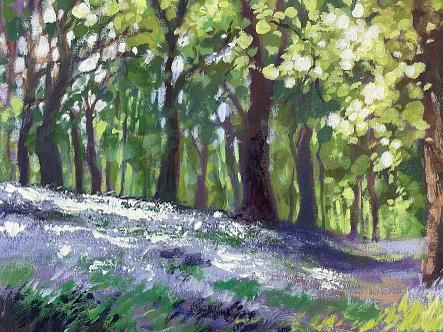
Join us with your acrylic paints and enjoy mixing a series of different greens to bring springlike warmth to your palette. In this step-by-step workshop, we will use a very simple composition to help us concentrate on the colour element, using a little technical theory along the way. Simpler than it looks, we will have a good insight into which colours to use for a harmonious woodland scene. You will never fear green again!
Suitable for all abilities.
You will need: Any surface to paint on, preferably primed first with a white emulsion to stop the paint soaking in - watercolour paper, canvas or board will do fine, at whatever size you feel comfortable with. A selection of brushes, a palette and water pot, plus the following colours (or as near as you have) White (preferably titanium) magenta or crimson/crimson alizarin (anything pink but not orange!), lemon yellow (not cadmium!) cerulean blue, and ultramarine blue, also burnt sienna is useful.

Make a free website with Yola